.avif)

Silk Kimono with Fans, Bamboo, and Ume on Blue Ground
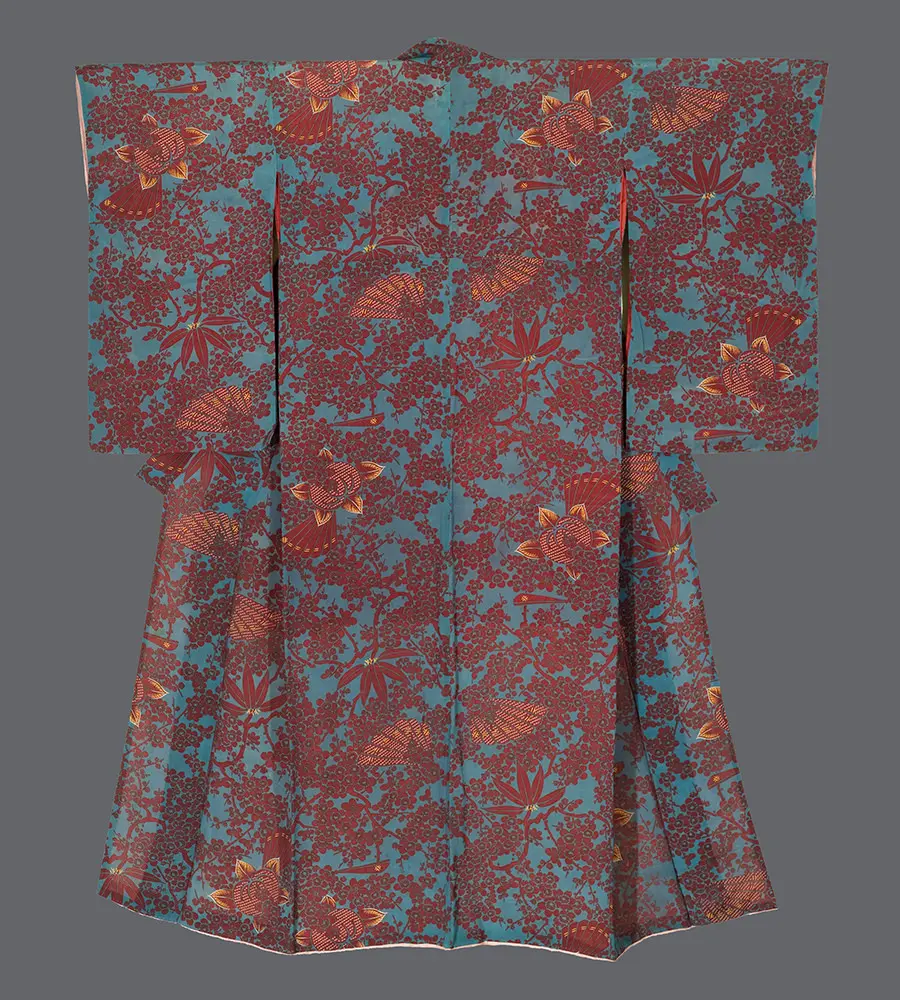


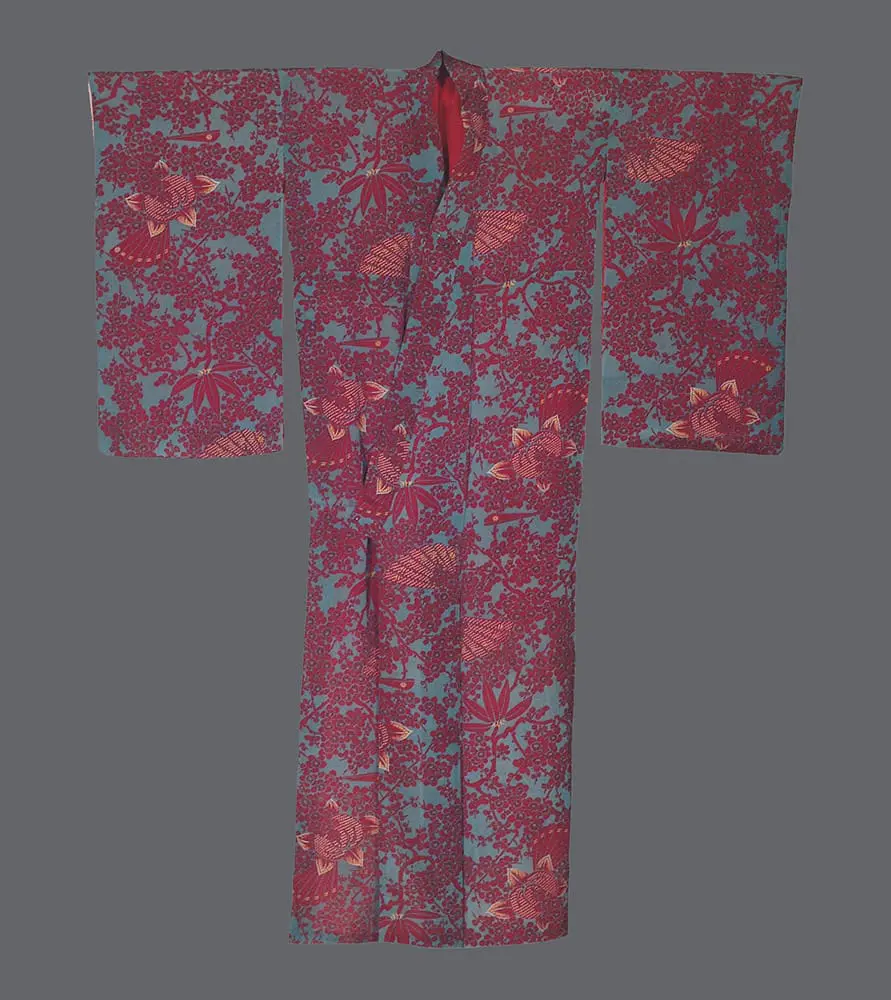
This silk kimono presents a dense, all-over pattern of small red and yellow folding fans interwoven with bamboo stalks and sprays of ume (plum blossom) set against a softly saturated blue ground. The design is rhythmically dispersed rather than formally spaced, creating a lively surface in which motifs seem to float and overlap, lending the textile a sense of movement and visual depth. The restrained scale of the imagery allows the pattern to read as a continuous field, while subtle variations in tone prevent it from becoming visually static.
Although the surface has a batik-like character—suggested by the softly modulated edges and the layered appearance of color—the pattern was most likely produced using silkscreen techniques. This method enabled precise repetition while still allowing for painterly nuance through careful control of pigment density and registration. The result is a balance between graphic clarity and organic softness, characteristic of early twentieth-century Japanese experimentation with modern production processes.
The motifs themselves carry well-established symbolic associations. Fans (ōgi or sensu) are auspicious emblems of expansion and prosperity, their radiating form suggesting growth and unfolding fortune. Bamboo signifies resilience, flexibility, and integrity, remaining evergreen and unbroken even under adversity. Ume blossoms, which flower in late winter, traditionally represent renewal, perseverance, and refined beauty. Together, these elements form a layered symbolic program that blends seasonal imagery with wishes for longevity and good fortune.
Chromatically, the contrast between the cool blue ground and the warm reds and yellows heightens the decorative impact while maintaining harmony.
It measures 49 inches (124 cm) from sleeve-end to sleeve-end and stands at 59 inches (150 cm) in height.
Display & Installation Notes


Payment Options: We primarily accept PayPal for all transactions. Credit and debit cards are not accepted. If you prefer to pay by personal check instead of PayPal, please note this preference in the "Additional comments" field when placing your order.Ordering Process
To receive your PayPal invoice, simply fill out the form.
Shipping Details: We ship all orders to the address associated with your PayPal payment. Please ensure your PayPal shipping address is current and accurate.A phone number is required during checkout, as our shipping carrier may need to contact you regarding delivery questions.Shipping RatesUnited States and Canada: $20International destinations (air mail): $40